A garage door that sounds noticeably louder in the morning than it does in the evening is a common complaint, and it is worth taking seriously without panicking about it. The noise itself is real — you are not imagining it — but the reason for the difference is not always obvious, and it is easy to jump to a conclusion that sends you chasing the wrong part. What follows is how a technician thinks through this problem: what to listen for, which causes are mechanically certain and which are only possibilities, and how to separate them with your eyes and ears rather than your hands.
Start by describing the noise honestly
"Louder" covers a lot of ground. Before anything else, pin down what the sound actually is, because different noises point to different parts of the system. A dry steel roller running on a track produces a high, rhythmic squeal that rises and falls with the door's travel. A loose hinge or bracket produces a rattle or clatter at a specific point in the cycle. A groan or grinding sound often comes from the opener's rail or drive. A single sharp pop at the start of a cycle is a different animal entirely from a continuous scrape.
Write down three things: what the noise sounds like, roughly where in the door's travel it happens, and whether it is present every time or only sometimes. That description is genuinely useful to a technician, and it costs you nothing to gather.
Ask whether the door itself has changed
Sometimes the noise is not new at all — your morning routine is just quieter, and you hear the door without the daytime background of traffic, neighbors, and air conditioning. That is a real effect and worth ruling out first. Run the door in the evening when the house is quiet and compare. If it sounds the same at both times, the door has probably been this loud for a while and you are simply noticing it now.
If it genuinely is louder in the morning, look at what is visible from outside the door with the garage empty. Does the door sit crooked in the opening? Is there a gap along the top that was not there before? Does the door feel heavier when you lift it by hand with the opener released? Does it drop instead of staying where you put it? Any of these observations is worth reporting, and none of them requires you to touch the springs, cables, or opener drive train.
Loose hardware and dry rollers are the usual suspects
Two causes are mechanically certain and account for a large share of noise complaints. The first is a dry steel roller. A roller that has lost its lubrication squeals against the track, and the sound is consistent and easy to place once you know what you are hearing. The second is loose hardware — hinge plates, brackets, and track fasteners that have worked slightly loose over time. A door that rattles at one specific point in its travel is often telling you a fastener has backed off.
Both of these are routine maintenance items, and both are addressed during a tune-up. A technician lubricates the rollers, hinges, and track, checks the fasteners, and confirms the door is running smoothly through its full cycle. If you have never had the door serviced, this is the sensible first step, and it is also the point at which a technician inspects the springs and cables for wear.
What the technician checks that you should not
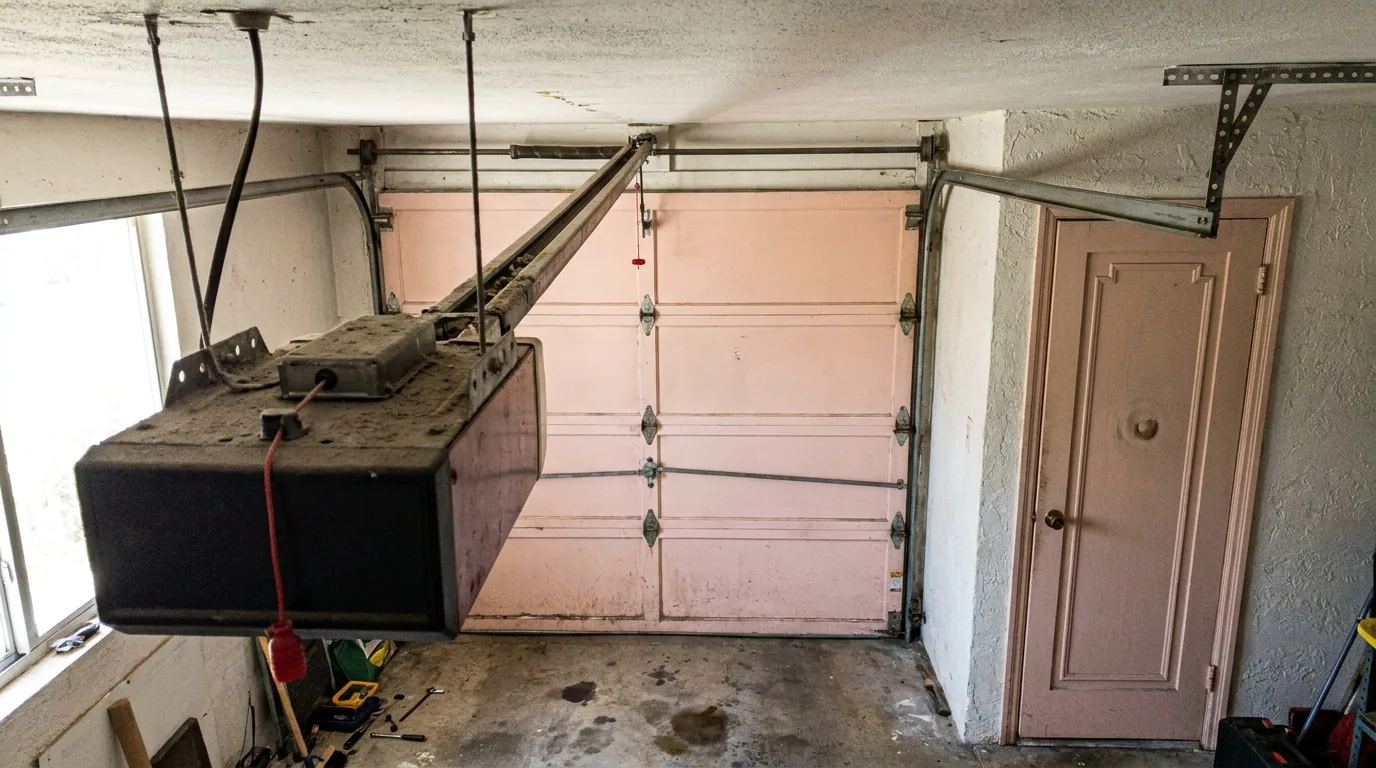
The springs, cables, and opener drive train carry stored energy and are not homeowner territory. A technician checks spring tension, cable condition, and the opener's force and travel settings as part of a service visit. If the door is hanging at an angle, that points to a cable problem, and it should be left alone until someone qualified looks at it. If the opener motor runs but the door does not move, a stripped gear is a likely explanation, and again that is a technician's call.
In Miami-Dade County, salt air is a practical concern for anyone on or near the barrier islands. Steel hardware corrodes faster here than it does well inland, which means springs, cables, and hinges can reach the end of their service life sooner than a homeowner expects. That does not explain a morning-versus-evening difference by itself, but it is a reason to have the hardware inspected on a regular schedule rather than waiting for a failure.
When to call and what to say
Call for service when the noise is accompanied by any change in how the door moves: a crooked hang, a gap at the top, a door that feels heavier, a door that reverses before reaching the floor, or an opener that runs without moving the door. Those are symptoms a technician needs to see, and describing them accurately on the phone helps the visit go faster.
If the door otherwise operates normally and the only issue is noise, a tune-up and safety inspection is the right starting point. Reach 911 Garage Door Repair & Service of Collins Miami at (786) 709-9487 or info@911garagedoorrepairmiami.com. The company serves Miami-Dade County and is licensed and insured. Weekday hours are 7:00 AM to 8:00 PM Monday through Saturday, Sunday is emergency service only, and 24/7 emergency dispatch is available.